
3 Aligner Cases Compared: Do Materials and Air Holes Really Matter?
October 21, 2026
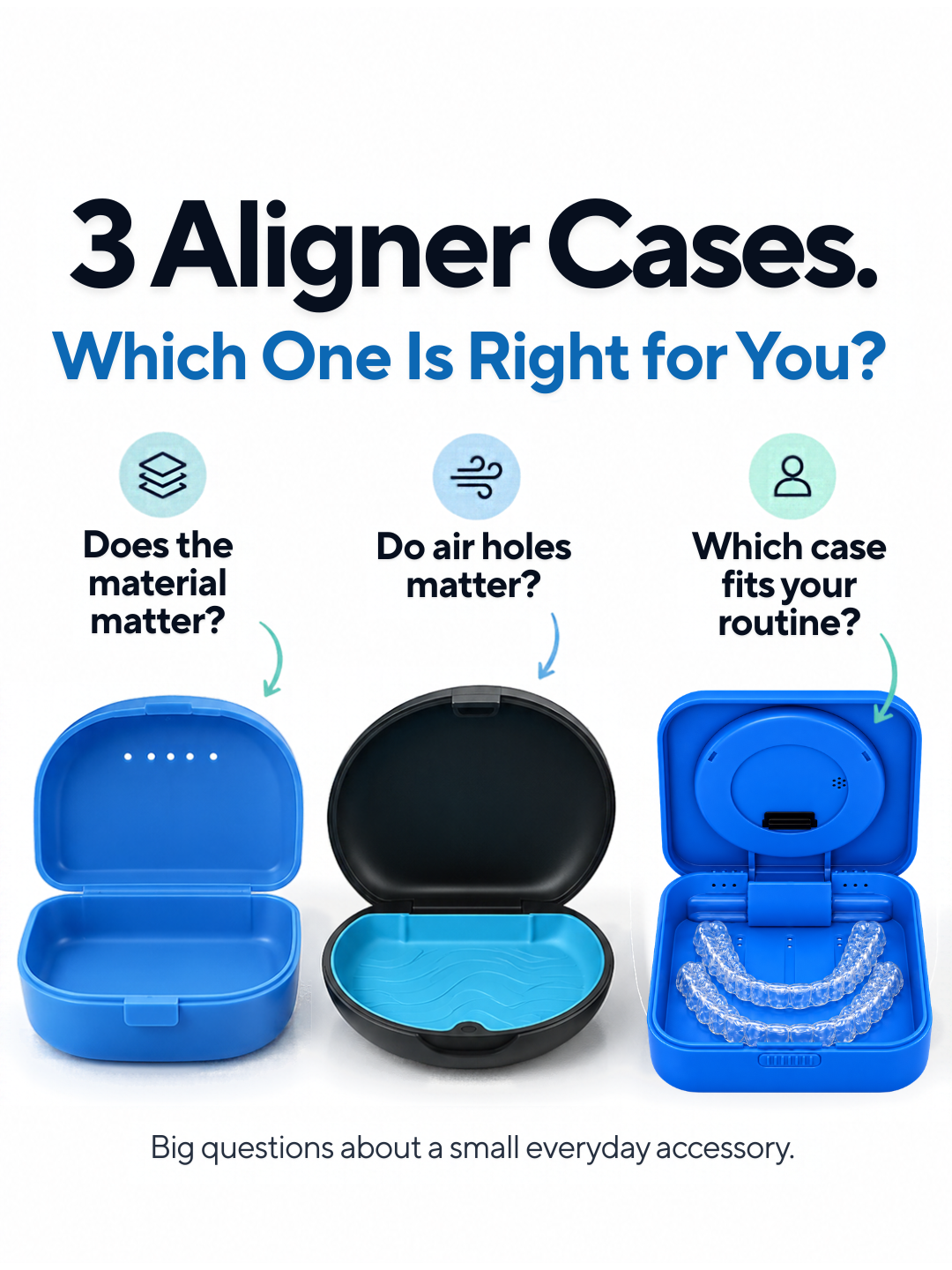
Your aligner case might be the accessory you use most during treatment. But have you ever wondered what actually makes a good one?
Does silicone make a case better? Are ventilation holes necessary? And could the wrong design encourage bacteria and bad smells?
We compared three familiar options: the Simple Case, the Invisalign Case, and TimerAligner, to explore what matters beyond appearance.
1. Does the Material Really Matter?
Food-grade and medical-grade plastics are designed to meet specific safety requirements. But safe materials aren't automatically bacteria-proof.
Silicone lining has advantages. Its soft surface can cushion aligners and help prevent them from sliding around. But there's an interesting trade-off.
A 2017 laboratory study found that E. coli bacteria attached more readily to silicone than to polypropylene plastic under the conditions tested.
That doesn't mean all silicone is unhygienic. The study wasn't conducted on aligner cases, and bacterial adhesion depends on the material, surface finish, and microorganisms involved.
The takeaway: Look for safe materials and smooth, accessible surfaces that are easy to wash and dry, not just a soft or premium-looking interior.
2. Do Air Holes Actually Matter?
Moisture and poor ventilation can create conditions that favor microbial growth.
Although the experiment wasn't conducted on aligner cases, it helps explain why ventilation and moisture management matter.
Here's something surprising: even Invisalign's closed-looking case includes ventilation behind its hinge.
But more holes don't automatically mean fewer bacteria. Hole placement, drainage, actual drying conditions, and cleaning habits also matter.
The takeaway: Good ventilation is useful, but it's not a substitute for cleaning.
3. Three Cases, Three Different Approaches
The Simple Case: Usually made from hard plastic, often polypropylene, with visible ventilation holes and a snap closure. It provides basic protection without extra features. 3M Unitek's ventilated retainer cases are one example.
The Invisalign Case: A slim design made from medical-grade thermoplastic, featuring a magnetic closure, textured interior to reduce shifting, and ventilation behind the hinge. It suits patients who value compact, elegant storage. The manufacturer describes a textured lining but doesn't identify it as silicone.
TimerAligner: Full disclosure, this is our product. It uses food-grade ABS/PC plastic with materials documented as meeting applicable FDA food-contact requirements, plus ventilation and drainage holes. Its main difference is a built-in countdown timer with sound, vibration, and light reminders to help patients remember to put their aligners back in. No app required.
Each design addresses a different everyday need. No direct clinical comparison has established which of these three cases is the most hygienic.
4. What About Bacteria, Odors, and Cleaning?
The case isn't the only place bacteria can accumulate. Clear aligners themselves can develop microbial biofilm.
A 2024 systematic review covering 11 studies found that combining mechanical and chemical cleaning approaches was effective in the protocols examined, although the overall certainty of evidence was limited.
Whatever case you choose, follow a simple routine: clean your aligners as directed, regularly wash the empty case according to its manufacturer's instructions, and allow it to dry completely before closing it for storage.
A ventilated case still needs cleaning. A premium lining still needs cleaning. And a built-in timer doesn't change that.
The Bottom Line: Which Case Is Best?
There's no universal winner.
The Simple Case offers basic protection and ventilation. Invisalign focuses on slim design, secure closure, and a textured interior. TimerAligner adds reminders for patients who sometimes lose track of their breaks.
The ideal aligner case combines safe materials, practical ventilation, easy cleaning, reliable protection, and features that fit your routine.
Choose the one you'll actually use and keep clean.
Sources & Credits
-
Adnan et al. (2017) - Role of bolA and rpoS genes in biofilm formation and adherence pattern by Escherichia coli on polypropylene, stainless steel, and silicone surfaces. PubMed
-
Qiu et al. (2022) - The Effects of Ventilation, Humidity, and Temperature on Bacterial Growth and Bacterial Genera Distribution. Full study
-
Pardo et al. (2024) - Home Biofilm Management in Orthodontic Aligners: A Systematic Review. PubMed
-
Invisalign - Official Aligner Case specifications
-
3M Unitek / Solventum - Ventilated Retainer Case specifications
-
AlignersWorld - TimerAligner product specifications
This article is general education, not medical advice.


