
Clear Aligner Accessories: What Do You REALLY Need? The Complete Must-Have vs. Nice-to-Have Guide
October 26, 2026
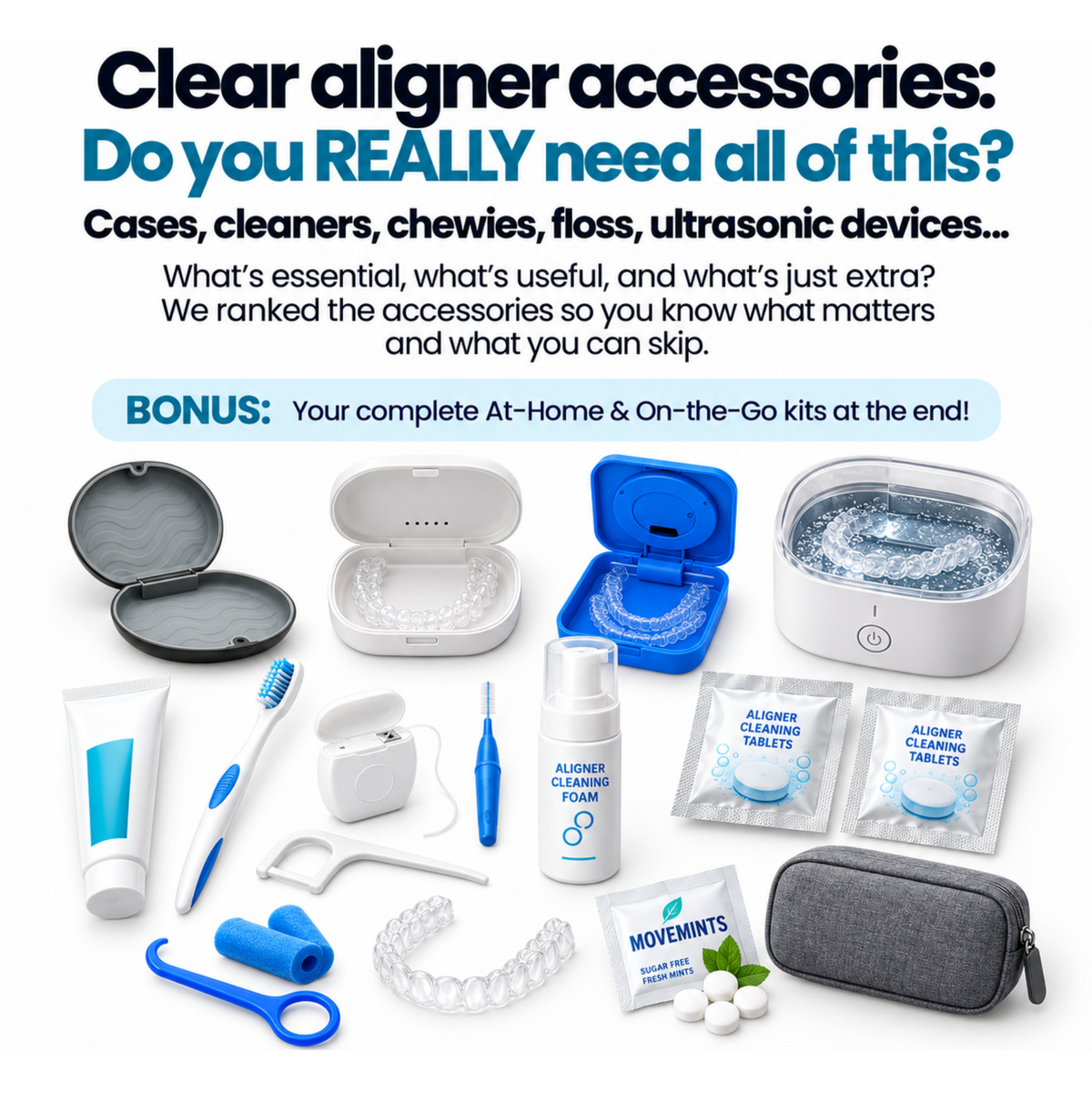
Cases, cleaning tablets, foam, chewies, floss, ultrasonic cleaners and more. Here's what matters, what makes life easier, and what you can probably skip.
Starting clear aligner treatment comes with a surprising discovery: there are a LOT of accessories out there.
At first, you think you're getting a set of nearly invisible aligners to straighten your teeth.
Then come the questions.
Do you need a special cleaning solution? Is an ultrasonic cleaner worth buying? What's the difference between regular floss and a water flosser? Are chewies necessary? And why are there so many different kinds of aligner cases?
Suddenly, your bathroom counter looks like it could use its own dental supply cabinet.
But here's the good news: you don't need to buy everything.
Some products are genuinely important for protecting your teeth, keeping your aligners clean and maintaining good treatment habits. Others can make everyday life considerably easier. And some are optional upgrades that may be nice to own but aren't necessary for everyone.
In this guide, we'll go through the most common clear aligner accessories, explain what each one does, and help you decide what's worth keeping in your routine.
We'll also build two practical kits:
-
Your At-Home Aligner Kit: Everything worth keeping in your bathroom.
-
Your On-the-Go Aligner Kit: The essentials to carry to work, school, restaurants or while traveling.
Let's find out what deserves a place in your aligner routine.
First, Why Do Clear Aligners Need So Much Extra Care?
Clear aligners may look simple, but the routine surrounding them is an important part of treatment.
Unlike fixed braces, aligners are removable. This makes eating and cleaning your teeth more convenient, but it also means you are responsible for taking them out, storing them safely, keeping them clean and putting them back in.
There are three main reasons why good habits matter.
1. Your Teeth Still Need Excellent Oral Hygiene
Aligners fit closely over your teeth. If food particles and plaque remain on your teeth when you put your aligners back in, you're not starting with a clean mouth.
Plaque is a sticky layer of bacteria that forms naturally on teeth. If it isn't removed regularly, it can contribute to cavities and gum inflammation.
That's why the American Dental Association (ADA) recommends brushing twice a day with fluoride toothpaste and cleaning between your teeth daily.
During aligner treatment, cleaning your teeth after meals before reinserting your aligners becomes an important additional habit.
2. Your Aligners Need Cleaning Too
Your aligners spend much of the day in contact with saliva, teeth and oral bacteria.
Over time, buildup can develop on their surfaces, contributing to unwanted odors, cloudiness or staining.
A 2024 systematic review on home biofilm management in orthodontic aligners examined different cleaning methods. The findings suggested that combining mechanical cleaning, such as gentle brushing, with appropriate chemical cleaning may be helpful.
However, the researchers also reported that the available evidence was limited.
In other words, cleaning matters, but there is no scientific reason for everyone to purchase every cleaning product available.
3. Aligners Work Only When They're Worn as Prescribed
Clear aligners are designed to apply planned forces to your teeth. Consistent wear is part of how your orthodontist carries out that treatment plan.
For example, Invisalign explains that its aligners are typically worn for 20 to 22 hours per day, although your own orthodontist's instructions should always come first.
Meal breaks, snacks and forgotten reinsertion can take time away from your planned wear schedule.
That's where a protective case, a reliable routine and helpful reminders become valuable.
The goal isn't to collect accessories. It's to make the habits that matter easier to follow.
Understanding Our Rankings
We'll divide accessories into three categories.
| Category | What It Means |
|---|---|
| MUST HAVE | Essential equipment or habits for daily hygiene, safe aligner storage and proper care. |
| VERY USEFUL | Products that solve common problems or make your routine more convenient. |
| NICE TO HAVE | Optional upgrades that can be helpful but aren't necessary for most patients. |
One important distinction: when we call something a MUST HAVE, we often mean that the function is essential, not that you must purchase a particular brand or device.
For example, daily cleaning between your teeth is essential. Owning traditional floss, floss picks, interdental brushes and a water flosser all at once is not.
Now let's look at the products.
PART 1: THE MUST-HAVES
1. A Protective Aligner Case
Our rating: MUST HAVE
If there's one aligner accessory you should always have nearby, it's a protective case.
Why?
Because aligners are small, transparent, removable and surprisingly easy to lose.
They can disappear into napkins, get left on restaurant tables, fall out of pockets or end up somewhere a pet can reach them.
The American Association of Orthodontists (AAO) specifically warns that removable aligners can be lost or damaged, including when they're wrapped in napkins and accidentally thrown away.
A proper case gives your aligners a designated place whenever they're not in your mouth.
What Makes a Good Aligner Case?
Look for:
-
A secure closure.
-
Enough room for your aligners without crushing them.
-
A design that's easy to open and close.
-
A surface that's easy to clean and dry.
-
A size that fits conveniently into your everyday bag.
What Types of Cases Are Available?
Standard aligner cases
Simple, practical and widely available. Their main job is to protect your aligners when you're not wearing them.
Invisalign cases
Cases designed for Invisalign users, generally offering the same core protective function with a recognizable brand design.
TimerAligner smart case
TimerAligner is a patented aligner and retainer case with a built-in countdown timer.
When you remove your aligners, you can place them in the case and set a reminder for when it's time to put them back.
The case uses sound, vibration and LED alerts, and the timer works without a phone or app.
It's designed for patients who want to manage their aligner breaks without relying entirely on memory.
Do You Need a Smart Case?
Not necessarily.
The essential item is a protective case.
A built-in reminder is an additional convenience feature that may be particularly useful if you often get distracted during meals or forget how long your aligners have been out.
A reminder does not measure actual wear time or guarantee that you'll follow your treatment schedule.
Common Case Mistakes
Avoid:
-
Wrapping aligners in napkins.
-
Putting loose aligners into a pocket or handbag.
-
Leaving the case in excessive heat.
-
Storing dirty aligners for long periods without cleaning them.
-
Forgetting to clean and dry the case itself.
Our verdict: Every aligner patient needs a dependable case. Choose the type that best supports your daily routine.
2. A Soft or Extra-Soft Toothbrush
Our rating: MUST HAVE
Your toothbrush might be the least exciting accessory on this list, but it's also one of the most important.
During clear aligner treatment, maintaining clean teeth is essential.
A toothbrush helps remove plaque and food particles before you put your aligners back in.
Why Soft Bristles?
Harder brushing is not necessarily better brushing.
The ADA recommends a soft-bristled toothbrush and advises against aggressive scrubbing, which can harm gums and enamel.
A soft or extra-soft brush makes it easier to clean gently.
Extra-soft bristles may be particularly comfortable for patients with sensitive gums, although the most important factors are proper technique and thorough cleaning.
Manual or Electric?
Both can be suitable.
A manual toothbrush can work well when used correctly.
An electric toothbrush may be easier for some patients, especially those who find it difficult to brush thoroughly with a manual brush.
You don't need the most expensive model to maintain good oral hygiene.
A Practical Brushing Routine
-
Brush twice daily for two minutes with fluoride toothpaste.
-
Clean all tooth surfaces gently.
-
Pay attention to the gumline and back teeth.
-
Brush after meals before reinserting aligners when possible.
-
Replace your toothbrush approximately every three to four months, or sooner if the bristles are worn.
What If You Can't Brush Immediately After Eating?
It happens.
If you're at a restaurant or traveling without your toothbrush, rinse your mouth thoroughly with water as a temporary measure, then brush when you can.
Ask your orthodontist how to balance oral hygiene and prescribed wear time when brushing isn't immediately possible.
Our verdict: A good soft toothbrush is more important than most expensive aligner gadgets.
3. Fluoride Toothpaste
Our rating: MUST HAVE
You probably already own toothpaste.
The important question is whether you're using the right type.
For most patients, a fluoride toothpaste is a sensible everyday choice.
Why Fluoride Matters
Fluoride helps strengthen tooth enamel and protect against cavities.
The ADA recommends brushing twice daily with fluoride toothpaste.
That's especially worth remembering during orthodontic treatment, when you may be brushing after additional meals.
What Should You Look For?
Choose a toothpaste that:
-
Contains fluoride.
-
Is appropriate for your age and dental needs.
-
Feels comfortable for regular use.
-
Has a recognized dental acceptance mark where available.
You generally don't need a special toothpaste marketed specifically for clear aligner patients.
Important: Toothpaste for Teeth vs. Toothpaste for Aligners
These aren't necessarily the same thing.
Some aligner manufacturers permit gentle cleaning with mild toothpaste. Others recommend different cleaning products or caution against abrasive formulas.
Certain toothpaste ingredients may scratch or dull some aligner materials.
Always follow the cleaning instructions for your particular aligners rather than assuming that your everyday toothpaste is suitable for the plastic.
Our verdict: Fluoride toothpaste is a basic oral hygiene essential. Specialty marketing is optional.
4. Traditional Dental Floss
Our rating: MUST HAVE, or an appropriate alternative for daily interdental cleaning
Your toothbrush cleans many exposed tooth surfaces, but it cannot effectively reach every space between your teeth.
That is why cleaning between your teeth matters.
The ADA explains that interdental cleaning helps remove plaque and debris from areas a toothbrush can't reach easily.
Why Does It Matter During Aligner Treatment?
When you remove your aligners to eat, food can become trapped between your teeth.
Putting aligners back over a mouth that hasn't been cleaned properly is not ideal.
Daily interdental cleaning supports gum health and helps reduce plaque buildup.
How to Use Traditional Floss
-
Gently guide the floss between two teeth.
-
Curve it into a C shape against one tooth.
-
Move it carefully along the tooth surface.
-
Repeat against the neighboring tooth.
-
Use a clean section as you move between spaces.
Avoid snapping floss forcefully into your gums.
Waxed or Unwaxed?
Either may work.
Some patients prefer waxed floss because it slides more comfortably through tight spaces.
The important part is using it correctly and consistently.
Our verdict: Daily cleaning between teeth is essential. Traditional floss is a reliable and affordable way to do it.
5. Floss Picks
Our rating: VERY USEFUL
Traditional floss is excellent, but pulling out a roll of floss in a public bathroom isn't everyone's favorite activity.
That's where floss picks come in.
These small plastic handles hold a short section of floss, making them convenient to carry and easy to use in many situations.
Why Patients Like Them
Floss picks can be useful when:
-
You're at work or school.
-
You're eating at a restaurant.
-
You need a compact cleaning tool.
-
You find regular floss difficult to handle.
-
You want to keep an oral hygiene kit in your bag.
Are Floss Picks as Good as Traditional Floss?
They can be helpful, but technique matters.
A traditional length of floss gives you more freedom to curve the floss around each tooth and use a fresh section as you move through your mouth.
With a floss pick, you need to be particularly careful to clean both neighboring tooth surfaces rather than simply moving straight up and down.
The ADA includes floss picks among available interdental cleaning tools.
One Important Rule
Don't reuse disposable floss picks.
Used floss can become worn or contaminated.
Our verdict: A very practical addition to an on-the-go aligner kit, especially if convenience helps you clean more consistently.
6. Interdental Brushes
Our rating: VERY USEFUL, when suitable
Interdental brushes are tiny brushes designed to clean between teeth.
They come in different shapes and sizes, often resembling miniature bottle brushes.
Who Might Benefit?
They may be useful for patients with:
-
Wider spaces between certain teeth.
-
Areas where regular floss is difficult to use.
-
Particular gum or dental conditions.
-
Recommendations from their dentist or hygienist.
Why Size Matters
An interdental brush needs to fit the space being cleaned.
A brush that's too large can cause discomfort or injure gum tissue if forced between teeth.
The ADA notes that the most appropriate interdental tool can depend on the size and shape of the spaces between a patient's teeth.
How to Use Them
-
Select a suitable size.
-
Insert gently without forcing.
-
Move the brush through the space according to its instructions.
-
Clean or replace the brush as directed.
If you're unsure about sizing, ask your dental professional.
Our verdict: Excellent for certain spaces, but not everyone needs them.
PART 2: KEEPING YOUR ALIGNERS CLEAN
7. A Dedicated Aligner Cleaning Brush
Our rating: MUST HAVE as part of a suitable cleaning routine
Your teeth and your aligners are two different surfaces.
They should both be cleaned, but not necessarily with the same products or technique.
A separate soft brush can be a convenient tool for cleaning the surfaces of your aligners.
Why Use a Separate Brush?
A dedicated brush helps you establish a consistent routine and prevents confusion between products intended for teeth and those intended for appliances.
A small, soft-headed brush is often convenient for reaching the detailed tooth-shaped areas inside a clear aligner.
How to Clean Your Aligners Gently
A typical routine may include:
-
Remove your aligners carefully.
-
Rinse them under cool or lukewarm water.
-
Gently clean the surfaces using a soft brush and an approved cleaning method.
-
Rinse thoroughly when required by the cleaner's instructions.
-
Reinsert them after cleaning your teeth.
What Should You Avoid?
Hot water: Excessive heat can damage or distort some aligner materials.
Aggressive scrubbing: Heavy pressure or abrasive products may damage the surface.
Random household cleaners: Products designed for kitchen surfaces, clothing or bathrooms are not automatically safe for dental appliances.
Unapproved soaking solutions: Not every cleaner is compatible with every aligner material.
For example, Invisalign's cleaning instructions permit certain mild cleaning methods while specifically cautioning against some alternative products.
Because different brands and materials have different instructions, follow the guidance supplied with your aligners.
Our verdict: Daily aligner cleaning is essential. A separate gentle brush is a useful, inexpensive part of many cleaning routines.
8. Aligner Cleaning Tablets
Our rating: VERY USEFUL
Cleaning tablets are one of the most familiar aligner cleaning accessories.
They're typically designed to dissolve in water and create a solution for soaking your aligners.
What Do They Do?
Depending on their formulation, cleaning tablets may help loosen or remove deposits and reduce odor-causing buildup.
They can make an additional cleaning step relatively easy.
How Are They Used?
Although instructions vary, the basic process usually looks like this:
-
Prepare a container with the recommended amount of water.
-
Dissolve the appropriate cleaning tablet.
-
Place your aligners into the solution.
-
Soak for the manufacturer's specified time.
-
Rinse as directed before wearing them again.
Do not assume that every tablet uses the same soaking time or water temperature.
Are All Cleaning Tablets Safe for Aligners?
No.
Some products are designed for dentures, while others are specifically formulated and tested for particular clear aligners.
A product being sold as a dental cleaner does not automatically mean it is compatible with every type of orthodontic plastic.
Check the instructions from both the cleaner and the aligner manufacturer.
Do Tablets Replace Brushing?
Not necessarily.
A 2024 systematic review suggested that combining mechanical and chemical cleaning may be useful, although the certainty of available evidence was limited.
You should not assume that occasional soaking replaces an appropriate daily cleaning routine.
Our verdict: A convenient cleaning option, particularly at home. Useful, but not a mandatory purchase for everyone.
9. Aligner Cleaning Crystals
Our rating: VERY USEFUL
Cleaning crystals are another soaking-based option.
Instead of dissolving a tablet, you add a measured amount of cleaning powder or crystals to water.
Tablets vs. Crystals: What's the Difference?
The main visible difference is the product format.
Tablets come in solid form, while crystals or powders are poured from a packet or container.
The actual cleaning performance depends on their chemical formulation, concentration, contact time and compatibility with the appliance.
One form is not automatically better than the other.
A Real Example: Invisalign Cleaning Crystals
According to the official Invisalign Cleaning Crystals instructions, the process includes:
-
Rinsing the aligners.
-
Placing them in a cleaning container with warm, not hot, water.
-
Adding the specified packet.
-
Allowing the aligners to soak for at least 15 minutes.
-
Rinsing them thoroughly afterward.
These are instructions for that particular product, not a universal soaking schedule.
Who Might Prefer Crystals?
Patients who:
-
Already like soaking their aligners.
-
Want premeasured cleaning portions.
-
Prefer a dedicated cleaning system.
-
Have a suitable container at home.
Do You Need Both Tablets and Crystals?
Usually not.
They are different product formats that can serve similar cleaning purposes.
Choose an option compatible with your aligners that you find easy to use.
Our verdict: A useful alternative to cleaning tablets, not an additional requirement.
10. Aligner Cleaning Foam
Our rating: VERY USEFUL
Cleaning foam is one of the more convenient options for patients who spend much of their day away from home.
Instead of preparing a soaking container, a cleaning foam is applied directly to the aligner.
Why Is It Popular?
Convenience.
A small bottle can fit into a bag, making it practical for busy days, travel or a midday refresh.
How Does It Work?
That depends on the specific formula.
Some foams are designed for brief contact and rinsing, while others have particular no-rinse instructions.
For example, Invisalign Aligner Cleaning Foam is marketed as a portable cleaning product that can be applied directly to aligners and used according to its specific no-rinse directions.
That does not mean every cleaning foam is safe to leave in the mouth without rinsing.
Always read the individual product instructions.
When Is Foam Most Useful?
-
After lunch at work.
-
During travel.
-
When a soaking container isn't convenient.
-
As part of an approved daytime cleaning routine.
Does Foam Replace Brushing Your Teeth?
Absolutely not.
Cleaning your aligners and cleaning your teeth are separate tasks.
A cleaning foam is not a substitute for a toothbrush, fluoride toothpaste or proper oral hygiene.
Is Foam Better Than Tablets?
Not automatically.
Foam may win on portability, while tablets or crystals may be more convenient for a planned soaking session at home.
Their effectiveness depends on their ingredients, the cleaning protocol and the aligner material.
Our verdict: A useful convenience product, especially for people who frequently eat away from home.
11. Portable Aligner Cleaning Spray
Our rating: NICE TO HAVE
Cleaning sprays offer another portable format.
Like foams, they're designed for convenient application without necessarily requiring a full soaking setup.
Why Might You Want One?
A small spray bottle may fit more easily into a compact travel kit.
Depending on the formulation, a product may be intended for brief cleaning, odor management or refreshing an appliance.
What Should You Check Before Buying?
-
Is it specifically approved for clear aligners?
-
Does it need to be rinsed off?
-
How long should it remain on the aligner?
-
Is it compatible with your aligner brand and material?
-
Is it intended for cleaning, freshening or both?
Do You Need Foam and Spray?
Probably not.
Unless you have a specific reason to keep both, one suitable portable product is usually enough.
And remember: a portable cleaner is an additional convenience, not a reason to skip proper cleaning.
Our verdict: Handy for travel, but often redundant if you already carry a suitable cleaning foam.
12. Ultrasonic Aligner Cleaners
Our rating: NICE TO HAVE
Ultrasonic cleaners may be the most high-tech-looking accessories on this list.
They usually resemble small countertop containers filled with water.
Place your aligners inside, activate the device, and ultrasonic energy creates rapid movement within the liquid.
How Does Ultrasonic Cleaning Work?
Ultrasonic devices use high-frequency sound waves in a liquid to generate microscopic activity, including a process called cavitation.
This can help disturb deposits on the surfaces of objects placed inside the cleaner.
The technology is used in several fields, including dental equipment cleaning.
But does that make it necessary for clear aligners?
What Does the Research Say?
A 2026 laboratory study published in BMC Oral Health compared brushing, cleaning-solution soaking, ultrasonic cleaning and combinations of these methods on thermoplastic aligner materials.
The study found that brushing, particularly when paired with an appropriate chemical solution, performed well in removing the tested bacterial biofilm.
Ultrasonic cleaning showed some cleaning activity, but the researchers concluded that further optimization was needed.
Importantly, this was a laboratory study, not proof that one home cleaning device improves orthodontic treatment outcomes.
Earlier systematic reviews also found limited certainty when comparing aligner cleaning methods.
So, Is an Ultrasonic Cleaner Worth Buying?
It depends on your preferences.
Potential advantages:
-
A convenient countertop cleaning routine.
-
Less manual handling during certain cleaning steps.
-
Possible additional cleaning benefit when used appropriately.
Potential disadvantages:
-
Another appliance to purchase and maintain.
-
Requires cleaning of the device itself.
-
May take up bathroom counter space.
-
Compatibility and cleaning instructions vary.
-
It does not remove the need for proper oral hygiene.
Can You Put Cleaning Tablets Inside an Ultrasonic Device?
Only if the device manufacturer and the cleaning product instructions both permit that combination.
Not every cleaning solution is appropriate for every machine.
What About Heat?
Avoid using excessive heat.
Choose water temperature and cleaning settings that are appropriate for both the aligner material and the cleaning device.
The Bottom Line
An ultrasonic cleaner can be a convenience upgrade.
But research has not established that every aligner patient needs one, or that it is universally superior to a well-followed approved cleaning routine.
Our verdict: Nice technology to have, but definitely not the first accessory we'd buy.
PART 3: TOOLS THAT MAKE ALIGNERS EASIER TO USE
13. Aligner Removal Hooks
Our rating: VERY USEFUL
Some clear aligners are surprisingly easy to remove.
Others can feel tightly fitted, particularly when attachments are present.
If you've ever struggled to get a grip on the edge of an aligner, you've probably wondered whether there's a better way.
A removal hook may help.
What Is an Aligner Removal Hook?
It's a small handheld tool with a shaped tip designed to catch the edge of an aligner so you can lift it away from your teeth more easily.
Who Might Benefit?
Patients who:
-
Have difficulty gripping their aligners.
-
Wear aligners with several attachments.
-
Find removal awkward around certain teeth.
-
Want a dedicated removal tool for travel.
How Should You Use One?
The correct technique depends on the product and the design of your aligners.
For example, PULTOOL's instructions recommend starting from the back of the aligner, on the inner side away from attachments, and removing it gently.
The important word is gently.
A removal tool is designed to help with removal, not to lever against teeth, force attachments loose or bend an aligner aggressively.
What If Your Aligner Is Painful to Remove?
Don't simply pull harder.
If removal suddenly becomes much more painful or difficult, contact your orthodontist.
The problem could involve the fit, an attachment or another issue that needs professional attention.
Our verdict: One of the most practical optional tools for patients who regularly struggle with removal.
14. Aligner Chewies
Our rating: USEFUL WHEN NEEDED
Chewies are small, soft, often cylindrical accessories designed to help seat clear aligners.
To seat an aligner means helping it settle fully into its intended position over your teeth.
Why Would an Aligner Need Seating?
Every new aligner is designed around planned tooth positions.
When you first insert a new aligner, it may feel snug, and certain areas may not settle perfectly right away.
In appropriate cases, an orthodontist may recommend a seating accessory.
How Do Chewies Work?
You gently bite onto the seating accessory while wearing the aligner.
This applies pressure that can help settle the plastic over the teeth.
A 2025 article in BDJ Team discusses the use of chewies as one way clinicians may help patients achieve appropriate aligner seating.
Are Chewies Mandatory?
No.
Some patients are specifically instructed to use them, while others don't need them.
The amount and frequency of use should follow your orthodontist's recommendations.
Can Chewies Fix an Aligner That Doesn't Fit?
Not necessarily.
This is an important distinction.
A seating accessory may help an appropriately fitting aligner settle into place.
But if an aligner remains visibly separated from your teeth, repeatedly pops off, produces sharp pain or cannot be seated normally, don't keep biting harder in an attempt to force it.
Contact your orthodontist.
Our verdict: Useful when recommended, but not a universal requirement.
15. Munchies
Our rating: USEFUL WHEN NEEDED
Munchies are another type of aligner seating accessory.
Although their name may sound like a snack, Munchies are not candy.
They're specially shaped dental accessories, commonly made from medical-grade silicone, that are designed to help patients seat their aligners.
How Are They Different From Basic Chewies?
Traditional chewies are usually simple, soft cylinders.
Munchies come in more structured shapes, with different areas designed to help apply pressure at particular tooth positions.
For example, Munchies EPS includes designs intended for seating aligners in certain areas of the dental arch.
Do Different Shapes Matter?
They may matter for the way the device is used.
Different seating devices are designed with different shapes, firmness levels and intended contact points.
That doesn't mean the most complicated version is automatically better for your treatment.
What About Claims That Munchies Speed Up Treatment?
Some manufacturers promote benefits beyond seating, including faster tooth movement or improved comfort.
These claims should not be treated as guaranteed outcomes for individual patients.
The clearest practical purpose is assisting with aligner seating according to professional instructions.
Should You Buy Them?
Ask your orthodontist whether your treatment would benefit from this type of tool.
If you're already using another seating accessory correctly, you may not need a second one.
Our verdict: A specialized alternative to standard chewies, useful when your orthodontist recommends it.
16. Movemints
Our rating: USEFUL WHEN APPROPRIATE
Now we come to something genuinely different.
Movemints are specially shaped, sugar-free mints marketed for clear aligner patients.
Unlike Munchies, these are edible products.
What's Special About Them?
According to the official Movemints FAQ, they have a groove-shaped design that allows a patient to bite gently against the aligners.
Their intended purpose includes helping with seating while also providing a mint.
Are Movemints Just Regular Mints?
No.
Their shape and intended use distinguish them from ordinary candy or breath mints.
However, being sugar-free doesn't automatically make every candy safe or appropriate to consume while wearing aligners.
Most general aligner guidance recommends removing aligners for eating.
If you want to use a specialized mint with your aligners in place, confirm that the product is suitable for your treatment and follow your orthodontist's instructions.
Chewies vs. Munchies vs. Movemints
| Product | What It Is | Main Purpose |
|---|---|---|
| Chewies | Small soft cylindrical seating tools | Help seat aligners |
| Munchies | Shaped silicone seating devices | Targeted aligner seating |
| Movemints | Specially shaped sugar-free mints | Mint and aligner seating |
Do You Need All Three?
Definitely not.
They serve overlapping purposes.
Depending on your treatment, you may need one type, or none at all.
Our verdict: An interesting specialized option, but follow professional advice rather than treating it as an everyday requirement.
PART 4: OPTIONAL ORAL HYGIENE AND CONVENIENCE TOOLS
17. Water Flossers
Our rating: NICE TO HAVE
A water flosser is a device that directs a controlled stream of water between the teeth and along the gumline.
It can look like an electric toothbrush's larger, more complicated cousin.
But it's doing a different job.
What Does a Water Flosser Do?
A water flosser uses pulses of water to help remove food debris and plaque from areas between teeth.
Some models use a countertop water reservoir, while others are portable and rechargeable.
Is Water Flossing Effective?
The ADA explains that water flossers carrying its Seal of Acceptance have met its safety and effectiveness requirements for plaque removal and related gum-health benefits.
Water flossers can be particularly useful for people who have difficulty using traditional floss.
Can a Water Flosser Replace Traditional Floss?
The answer depends on the patient.
Traditional floss, interdental brushes and water flossers work in different ways.
A water flosser may be a reasonable daily interdental cleaning option for some people, while others may benefit from traditional floss or a combination of tools.
Your dentist or hygienist can help determine which method is most appropriate for your teeth and gums.
Why Isn't It a Must-Have?
Because the essential goal is effective daily cleaning between your teeth.
If you're already cleaning these areas well with traditional floss or another suitable tool, a water flosser may simply be an additional convenience.
Who Might Appreciate One?
-
Patients who dislike traditional floss.
-
People who find handling floss difficult.
-
Patients with specific dental work.
-
Anyone whose dental professional recommends one.
Our verdict: Potentially very useful, but not an automatic necessity for every aligner patient.
18. A Pocket Mirror
Our rating: NICE TO HAVE
Sometimes the simplest accessories are the most convenient.
A small mirror can help you check:
-
Whether your aligners appear properly seated.
-
Whether food is visibly stuck between your teeth.
-
Whether an attachment area needs a closer look.
-
Whether your teeth look clean after a meal.
Is It Medically Necessary?
No.
But it's small, inexpensive and easy to carry.
If you regularly remove and reinsert your aligners away from home, it may make your routine more comfortable.
One Important Limitation
A mirror cannot tell you whether your teeth are moving correctly.
If you're concerned about a persistent fit problem, a visible gap or significant pain, ask your orthodontist instead of trying to diagnose the issue yourself.
Our verdict: A convenient little extra, particularly for travel.
19. A Travel Pouch
Our rating: NICE TO HAVE
A travel pouch doesn't clean your teeth or protect your aligners directly.
What it does is keep your other accessories organized.
And sometimes, organization makes the difference between having the right tool with you and realizing you left it at home.
What Can You Keep Inside?
-
Your protective aligner case.
-
A compact toothbrush.
-
Travel toothpaste.
-
Dental floss or floss picks.
-
A suitable portable cleaner.
-
A removal tool if you use one.
What Makes a Good Travel Pouch?
Choose something that's:
-
Compact.
-
Easy to clean.
-
Large enough for your essentials.
-
Convenient to keep in your everyday bag.
Keep damp items hygienic and allow brushes to dry appropriately when possible.
Is a Special Aligner Pouch Necessary?
No.
A small toiletry pouch or organizer can work perfectly well.
Our verdict: Useful for building a consistent routine, but you don't need an expensive specialized bag.
PART 5: BUILD YOUR TWO COMPLETE ALIGNER KITS
Now that we've looked at the accessories individually, let's put everything together.
You don't need to carry your entire bathroom cabinet everywhere.
The smartest approach is to have a dependable home setup and a lighter kit for meals and travel.
Your At-Home Aligner Kit
Best for: Morning and evening cleaning, daily hygiene and organized aligner care.
The Essentials
| Product | Why It's Included |
|---|---|
| Protective aligner case | Keeps aligners safely stored when removed |
| Soft or extra-soft toothbrush | Gentle daily tooth cleaning |
| Fluoride toothpaste | Helps protect tooth enamel |
| Traditional floss or suitable interdental cleaner | Daily cleaning between teeth |
| Dedicated soft aligner brush | Supports gentle cleaning of the aligners |
| Approved aligner cleaning routine | Helps manage buildup and maintain hygiene |
Optional Upgrades
| Product | Why You Might Add It |
|---|---|
| Cleaning tablets or crystals | Convenient soaking option |
| Cleaning foam | A different approved cleaning format |
| Ultrasonic cleaner | Additional countertop cleaning convenience |
| Water flosser | An alternative or supplement to other interdental cleaning tools |
| Chewies or Munchies | Seating assistance if recommended |
| Removal hook | Easier removal if you struggle |
Our At-Home Recommendation
Start with the essentials.
If you want to upgrade your cleaning setup, choose one suitable additional cleaner before buying several overlapping products.
If you struggle with flossing, consider whether a different interdental tool could help.
If you have difficulty removing or seating your aligners, speak to your orthodontist about a specific tool.
Build your kit around your actual needs, not around the number of accessories available.
Your On-the-Go Aligner Kit
Best for: Work, university, restaurants, weekends away and travel.
The goal is simple: something small enough to carry without thinking twice.
Pack These First
| Product | Why It's Included |
|---|---|
| Protective aligner case | A safe place for your aligners during meals |
| Travel toothbrush | Cleaning after eating |
| Fluoride toothpaste | Maintaining your brushing routine |
| Floss picks or compact floss | Removing trapped food and cleaning between teeth |
Add These if You Find Them Useful
| Product | Why You Might Carry It |
|---|---|
| Portable cleaning foam or spray | A convenient aligner cleaning option |
| Removal hook | Helpful for difficult-to-remove aligners |
| Chewies or approved seating tool | For patients instructed to use one |
| Pocket mirror | Quick checks after meals |
| Travel pouch | Keeps everything together |
A Practical Restaurant Routine
Imagine you're having lunch away from home.
Before eating:
-
Remove your aligners.
-
Place them directly into their case.
-
Put the case somewhere secure.
After eating:
-
Clean your teeth, ideally by brushing.
-
Clean between your teeth if needed.
-
Rinse or clean your aligners as appropriate.
-
Reinsert them according to your treatment instructions.
-
Put your accessories back into the kit.
If you're unable to brush immediately, rinsing with water is a useful temporary step, but it doesn't replace a proper cleaning routine.
A small travel kit makes it easier to follow your usual habits even when you're not at home.
PART 6: WHAT SHOULD YOU BUY FIRST?
If you're just starting treatment and don't want to buy everything at once, here's our suggested order.
Priority 1: The Basics
Get these first:
-
A protective case.
-
A soft toothbrush.
-
Fluoride toothpaste.
-
Dental floss or another suitable interdental cleaner.
-
An appropriate method and supplies for daily aligner cleaning.
You may already own several of these.
Priority 2: Solve Your Everyday Annoyances
Think about what actually bothers you.
Always forgetting your aligners after meals?
A case with a reminder function or another reliable reminder routine may help.
Struggling to remove your aligners?
Ask about a removal hook.
Eating out frequently?
Build a compact travel kit.
Having trouble cleaning between your teeth?
Explore floss picks, interdental brushes or water flossers with guidance from your dental professional.
Finding your aligners difficult to seat?
Ask whether a seating tool is appropriate.
Priority 3: Convenience Upgrades
Only after the basics are covered should you consider optional extras like:
-
An ultrasonic cleaner.
-
Additional cleaning product formats.
-
A water flosser if your current interdental routine already works well.
-
A dedicated travel organizer or pocket mirror.
Remember that buying an advanced device won't automatically improve an inconsistent routine.
The accessory should solve a real problem, not create another task.
PART 7: COMMON ACCESSORY MISTAKES TO AVOID
Even well-intentioned patients can make simple mistakes with their accessories.
Here are some worth avoiding.
Mistake 1: Buying Every Cleaning Product at Once
Tablets, crystals, foam and sprays may overlap in purpose.
You usually don't need all of them.
Choose a suitable routine and use it consistently.
Mistake 2: Using Hot Water
Hot water can distort certain aligner materials.
Follow your manufacturer's instructions and avoid excessive heat.
Mistake 3: Using an Unapproved Cleaner
Don't assume denture cleaners, mouthwash, household detergents or other products are safe for your aligners.
Compatibility depends on the appliance material and product formulation.
Mistake 4: Treating Foam as a Replacement for Toothbrushing
Cleaning your aligners is not the same as cleaning your teeth.
Both need attention.
Mistake 5: Forcing a Seating Tool
Chewies and Munchies are not tools for forcing badly fitting aligners into place.
If an aligner remains significantly misaligned, will not seat or causes sharp pain, contact your orthodontist.
Mistake 6: Forgetting Your Case
A quick meal can become an expensive inconvenience if your aligners end up in the trash.
Make using your case an automatic habit.
Mistake 7: Buying Expensive Equipment Instead of Improving Basic Habits
An ultrasonic cleaner may be convenient.
A water flosser may be useful.
A smart case may provide a helpful reminder.
But none of these removes the need for proper cleaning, safe storage, consistent aligner wear and professional guidance.
PART 8: FREQUENTLY ASKED QUESTIONS
Do I really need special accessories for clear aligners?
You need suitable supplies for oral hygiene, safe aligner storage and proper aligner cleaning.
However, most additional gadgets are optional.
The exact equipment you need depends on your treatment instructions and personal routine.
What's the single most important aligner accessory?
A protective case is one of the most important aligner-specific accessories because it gives your aligners a safe place whenever you remove them.
But it works alongside essential oral hygiene supplies, not instead of them.
Do I need cleaning tablets every day?
Not necessarily.
The correct cleaning routine depends on your aligner material, the manufacturer's recommendations and your orthodontist's instructions.
Some patients use soaking products regularly, while others follow different approved cleaning methods.
Is cleaning foam better than cleaning tablets?
There's no universal answer.
Foam can be convenient for daytime use, while tablets may be practical for soaking at home.
Different formulations and instructions make direct comparisons difficult.
Choose a product compatible with your aligners that fits your routine.
Does an ultrasonic cleaner clean better than brushing?
Not necessarily.
Research comparing aligner cleaning methods is still developing.
A 2026 laboratory study found good performance from brushing-based methods, while ultrasonic cleaning showed partial effectiveness under the tested conditions.
That doesn't mean ultrasonic devices have no value. It means we shouldn't describe them as essential or universally superior.
Can I use regular toothpaste to clean my aligners?
It depends on your manufacturer's instructions.
Some brands permit mild toothpaste, while abrasive formulas may be inappropriate for certain materials.
Use the cleaning method recommended for your particular aligners.
Do I need to buy chewies?
Only if they are appropriate for your treatment.
Some orthodontists recommend them for seating. Others may not consider them necessary.
Don't use them to force an aligner that doesn't fit properly.
Are Munchies and Movemints the same thing?
No.
Munchies are shaped silicone seating tools.
Movemints are specially shaped, sugar-free mints marketed for clear aligner patients.
They are different products with different instructions.
Can a water flosser replace regular floss?
For some patients, a water flosser can be a suitable interdental cleaning tool.
Others may benefit more from traditional floss or interdental brushes.
Ask your dentist which approach suits your teeth, gums and dental history.
Do I need a special travel kit?
You don't need a specially branded kit.
But keeping a case, toothbrush, toothpaste and floss together makes daily care more convenient when you're away from home.
Can a timer case tell whether I'm wearing my aligners enough?
A countdown timer can remind you when a break is over.
That is different from objectively measuring actual aligner wear.
A timer does not confirm that your aligners are in your mouth or that treatment is progressing as planned.
What should I do if an accessory damages my aligner?
Stop using the accessory and inspect the aligner.
If the aligner is cracked, warped, sharp, painful or no longer fits properly, contact your orthodontist promptly.
Do not attempt to repair, reshape or force a damaged aligner yourself.
THE FINAL VERDICT: YOU DON'T NEED EVERYTHING
There are more clear aligner accessories available than ever.
Some are simple, like a toothbrush or a protective case.
Others are clever, like portable cleaning foams, specialized seating tools or ultrasonic cleaners.
But the best routine is not necessarily the one with the most products.
It's the one that consistently covers the fundamentals:
Keep your teeth clean.
Keep your aligners clean.
Store them safely.
Wear them according to your orthodontist's instructions.
Then add accessories that genuinely make those habits easier.
A removal tool may be useful if your aligners are hard to take out.
A water flosser may be helpful if regular floss is difficult for you.
A portable cleaner may make travel more convenient.
And a reminder-equipped case may help you keep track of time when your aligners are out.
None of these automatically replaces the fundamentals.
Start with the essentials. Add what helps. Skip what you don't need.
That's a much better approach than trying to own every aligner accessory on the market.
Sources and Further Reading
The recommendations in this article draw on professional dental guidance, peer-reviewed research and manufacturer instructions where product-specific details are required.
Professional Guidance
-
American Association of Orthodontists: Braces vs. Clear Aligners
Aligner wear, hygiene and loss prevention. -
American Association of Orthodontists: Living with Orthodontic Treatment
Eating, drinking and oral hygiene during aligner treatment. -
American Association of Orthodontists: Orthodontic Emergencies
Guidance on damaged and poorly fitting aligners. -
American Dental Association: Brushing Your Teeth
Soft toothbrushes, fluoride toothpaste and brushing habits. -
American Dental Association: Dental Floss and Interdental Cleaners
Traditional floss, floss picks, interdental brushes and related evidence. -
American Dental Association: Water Flossers
Water flossing, plaque removal and ADA acceptance criteria.
Scientific Research
-
Home Biofilm Management in Orthodontic Aligners: A Systematic Review (2024)
Review of aligner cleaning protocols and evidence limitations. -
Cleaning and Disinfection Protocols for Clear Orthodontic Aligners: A Systematic Review (2022)
Mechanical, chemical and combined cleaning approaches. -
Effects of Cleaning Methods on Biofilm Removal and Aligner Material Properties (2026)
Laboratory comparison of brushing, soaking, ultrasonic cleaning and combined methods. -
Evaluation of Microbial Colonisation on Clear Aligners With Different Cleaning Methods (2025)
Clinical crossover study comparing cleaning approaches in aligner patients. -
Orthodontics in the City: Top Tips to Improve Aligner Tracking (2025)
Professional discussion of aligner seating and chewies.
Manufacturer Instructions and Product Information
-
Invisalign: Frequently Asked Questions
General Invisalign wear and maintenance information. -
Invisalign: Cleaning Crystals
Product-specific soaking instructions. -
Invisalign: Aligner Cleaning Foam
Product-specific foam instructions and intended use. -
PUL Dental: Removal Tool FAQs
Removal tool guidance. -
Munchies: Clear Aligner Accessories
Types and intended use of Munchies seating tools. -
Movemints: Frequently Asked Questions
Product description and directions for specialized seating mints.
Note: Manufacturer sources explain the intended use of individual products. They should not be interpreted as independent evidence that a product improves orthodontic outcomes. Always follow the instructions provided for your specific aligners and consult your treating professional when necessary.
This article is general education, not medical advice.


