
Smoking With Clear Aligners Sometimes? The Real Consequences Patients Should Know
June 21, 2026
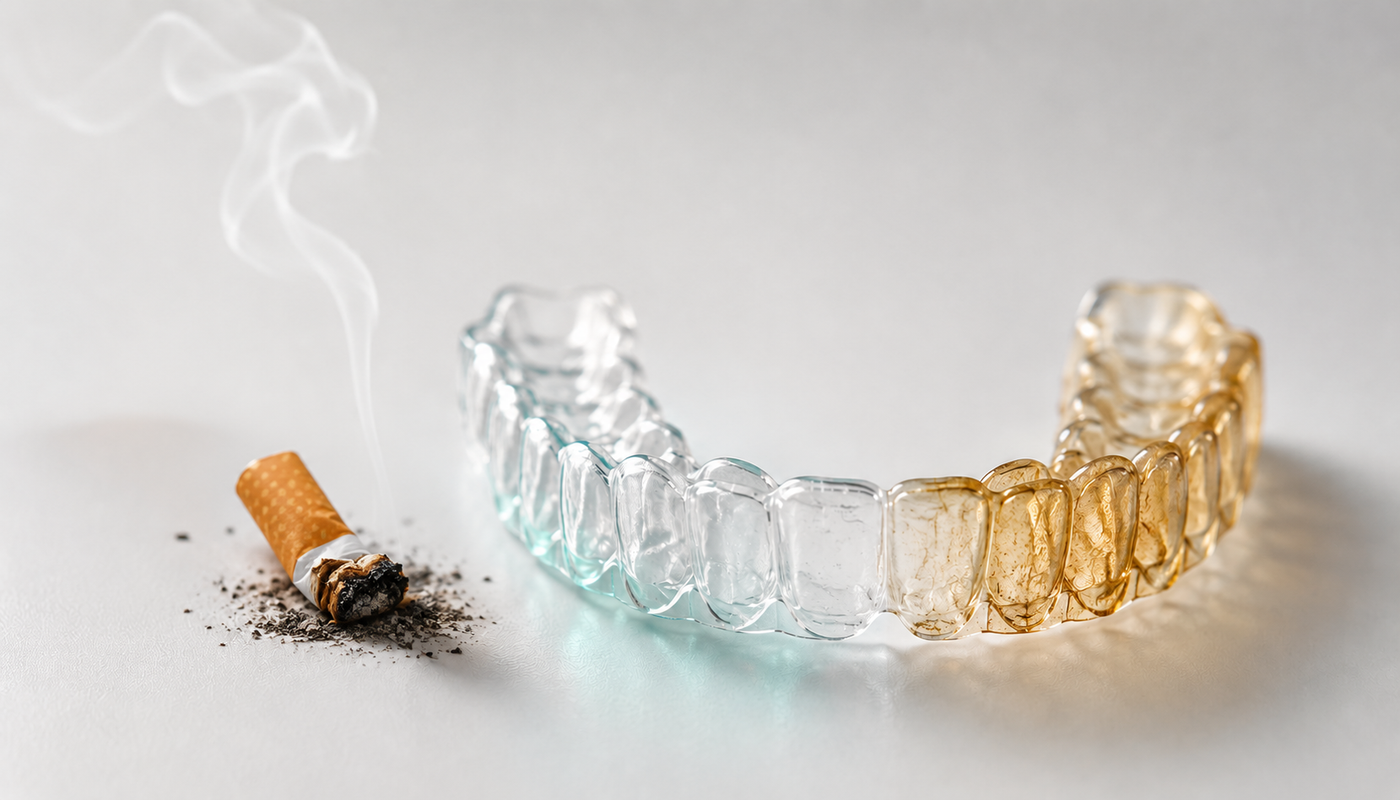
Everyone knows they should not smoke with clear aligners in. But in real life, some patients still do it occasionally. The question is not whether smoking is recommended. It is not. The real question is what can happen when a patient smokes with aligners, or puts them back in without cleaning properly afterward.
Clear aligners are usually worn for 20 to 22 hours per day. That means the trays sit tightly over the teeth for most of the day, trapping whatever is left on the tooth surface, saliva, plaque, food particles, odor, pigments and tobacco residue. When smoking is added to this environment, the problem is not only staining of the aligner. It may also affect the teeth, gums and the overall hygiene routine around treatment.
Tobacco is strongly linked to extrinsic tooth staining. Tar and nicotine can contribute to yellow, brown or dark discoloration on teeth, especially when plaque is present. Smoking is also associated with bad breath, reduced taste, gum disease and higher risk of tooth loss. One review cited that tooth loss may be 2 to 3 times higher in smokers than in non smokers. Another large study found that male smokers were about 3 times more likely to lose teeth than male non smokers, while female smokers were more than twice as likely to lose teeth than female non smokers.
For clear aligner patients, this matters because aligners can make poor hygiene habits more concentrated. If a patient smokes, then puts the trays back in without rinsing, brushing or cleaning, residues can remain pressed against the teeth. Over time, this may contribute to odor, stained trays, stained teeth and a less clean oral environment. Smoking can also make gum problems harder to notice because nicotine may reduce blood flow to the gums, which can reduce bleeding, one of the early warning signs patients usually recognize.
There is also the issue of appearance. Clear aligners are chosen because they are discreet. Smoking can work directly against that benefit. Even occasional smoking may leave odor or visible discoloration if the trays are worn during smoking or stored carelessly afterward. The aligners may still “fit,” but they may no longer feel fresh, clean or invisible.
The practical recommendation is simple: do not smoke while wearing aligners. If a patient does smoke, the aligners should be removed first and stored in a clean case, not wrapped in a napkin or placed in a pocket. Before reinserting, the patient should rinse the mouth, brush when possible and make sure the trays are cleaned daily according to the dentist or orthodontist’s instructions.
The bottom line: smoking with clear aligners is not just a cosmetic issue. It can affect tray clarity, breath, tooth color, gum health and the cleanliness of the entire treatment routine. Clear aligners work best when the patient’s daily habits support the treatment, not when the trays become a cover over tobacco residue.
References
Verywell Health, “Smoking and Dental Problems”
https://www.verywellhealth.com/smoking-and-dental-problems-1059118
The Guardian, “What is the impact of vaping on teeth and oral health?”
https://www.theguardian.com/society/2025/sep/25/impact-vaping-teeth-oral-health-decay
Health.com, “Effects of Smoking on Skin, Hair, Teeth, and Eyes”
https://www.health.com/condition/smoking/15-ways-smoking-ruins-your-looks
Wikipedia medical overview, “Health effects of smoking tobacco”
https://en.wikipedia.org/wiki/Health_effects_of_smoking_tobacco
Wikipedia medical overview, “Tooth discoloration”
https://en.wikipedia.org/wiki/Tooth_discoloration


